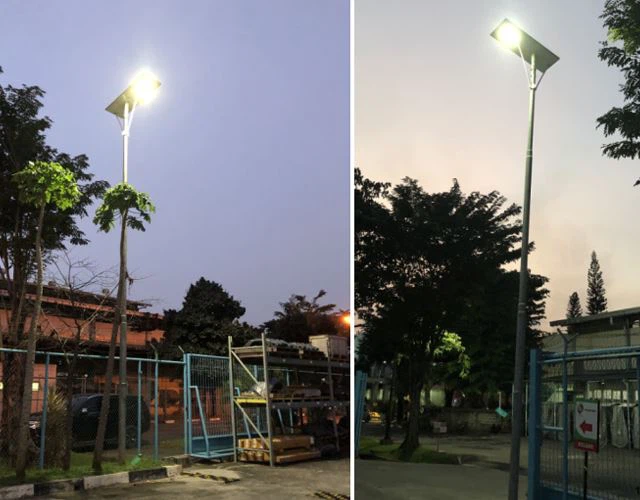
I’ve heard almost every argument about solar street lights1 — from “they don’t last long” to “they can’t work in cloudy weather.” After fifteen years dealing with lighting projects across Africa and Southeast Asia, I can tell you most of these claims come from misunderstanding, not from the technology itself. So, let’s talk straight. Here are the five biggest myths I’ve faced about solar street lights1, and what really happens on site.
Myth 1: Solar Street Lights Don’t Work on Cloudy or Rainy Days
That’s not true — good solar street lights1 keep running even through several cloudy or rainy days because of energy storage design.
Solar panels don’t stop producing energy under clouds; they just produce less. What matters is the battery autonomy2 — how many days of stored energy the system has. For example, we design most systems for 3 to 5 days of autonomy. That means even if there’s no sunlight for a few days, lights still run every night.
In rainy areas like Uganda or Malaysia, I’ve seen systems working fine because they used slightly larger panels and LiFePO₄ batteries3 with smart MPPT controllers4. The problem isn’t the weather; it’s poor sizing. Bad designs cut corners on panel or battery size.
So next time someone says “it won’t work in the rain,” ask: How many autonomy days did you design for?
Myth 2: Solar Street Lights Are Not Bright Enough
Modern solar street lights1 can easily match or exceed the brightness of traditional grid lights5 if designed correctly.
Early models used weak 20–30 W LEDs. That’s where the bad reputation started. But today, project-grade lights reach 150–200 lumens per watt, meaning a 60 W solar fixture can deliver 9000–12000 lumens — equal to a 250 W sodium lamp.
I once installed 120 units along a rural highway in Tanzania. Locals expected dim lights. When we powered them up, even the mayor said, “Too bright — reduce the angle!” Brightness isn’t the issue anymore. The issue is when suppliers sell “20 W panels + 40 W lamps” — physics doesn’t support that.
If the system’s balanced — right panel, right battery, right LED — solar light brightness is not a problem at all.
Myth 3: Solar Street Lights Are Too Expensive
Actually, when you count installation and long-term maintenance6, solar street lights1 often cost less than grid-connected lights.
Yes, the purchase price per unit can be higher. But you save a lot by skipping cables, trenching, and transformers. One of my projects in Cameroon showed this clearly: grid extension cost around $30 per meter, while solar needed zero wiring. The total system cost came out 22% cheaper after two years.
Also, there’s almost no electricity bill. Batteries and LEDs now last 5–10 years, so the main expense left is cleaning panels and tightening bolts.
The real trap is when people compare “lamp prices” only, not the full project scope. If you include trenching, permits, and labor — solar wins most times, especially outside city centers.
Myth 4: Solar Street Lights Need Constant Maintenance
That used to be true years ago, but now most systems are almost maintenance-free for the first five years.
I still remember climbing poles in early 2010 to replace gel batteries — heavy, leaky, and short-lived. Now, we use sealed lithium packs7 mounted in waterproof housings with smart BMS. No leakage, no acid, no mess.
Routine care is simple: clean panels twice a year, check bolts and wiring once a year. That’s it.
In one Togo project, 13,000 solar lights have been running since 2020. The maintenance team’s yearly report said 98.4% lights operational — better than many grid systems.
Of course, nothing is truly “zero maintenance.” If someone tells you that, don’t believe them. But the workload is tiny compared to old systems.
Myth 5: Solar Street Lights Don’t Last Long
With proper components and installation, solar street lights1 can last 10–15 years easily — sometimes longer.
The myth comes from cheap imports that fail after one or two years. I’ve seen this problem everywhere: undersized batteries, thin brackets, no galvanization. But those are quality issues, not solar technology problems.
A well-built unit with a hot-dip galvanized pole8, IP66 LED head9, LiFePO₄ battery, and MPPT controller easily lasts a decade. In Ethiopia, one of our early 2015 systems still works, only battery replaced once after eight years.
The key is not to buy the cheapest. Look for suppliers who provide full configuration data10 — panel wattage, battery capacity, controller type — not just “60 W light.”
Once you install a real system, it’ll probably outlive the politician who inaugurated it.
Final Thoughts
Most myths about solar street lights1 come from poor-quality products and lack of design understanding, not from the technology itself.
If you size the system right, use genuine components, and follow correct installation standards, solar lights work almost anywhere — rain or shine, rural or urban. I’ve watched entire communities light up without a single grid connection, and that’s something hard to argue with.
So next time someone says solar doesn’t work — smile. It probably means they haven’t seen a real project yet.
-
Explore the advantages of solar street lights, including cost savings and environmental benefits. ↩ ↩ ↩ ↩ ↩ ↩ ↩
-
Learn how battery autonomy ensures solar street lights function even in cloudy weather. ↩
-
Discover why LiFePO₄ batteries are preferred for solar street lights due to their longevity and safety. ↩
-
Understand how MPPT controllers optimize energy production in solar street lights. ↩
-
Find out how modern solar street lights can match or exceed the brightness of traditional options. ↩
-
Get insights into the cost-effectiveness of solar street lights compared to grid-connected systems. ↩
-
Learn about the advantages of using sealed lithium packs for reduced maintenance and increased reliability. ↩
-
Explore how hot-dip galvanization enhances the durability and lifespan of solar street light poles. ↩
-
Understand the significance of IP66 ratings for ensuring the weather resistance of solar street lights. ↩
-
Discover the importance of detailed specifications to ensure quality and performance in solar street lights. ↩